
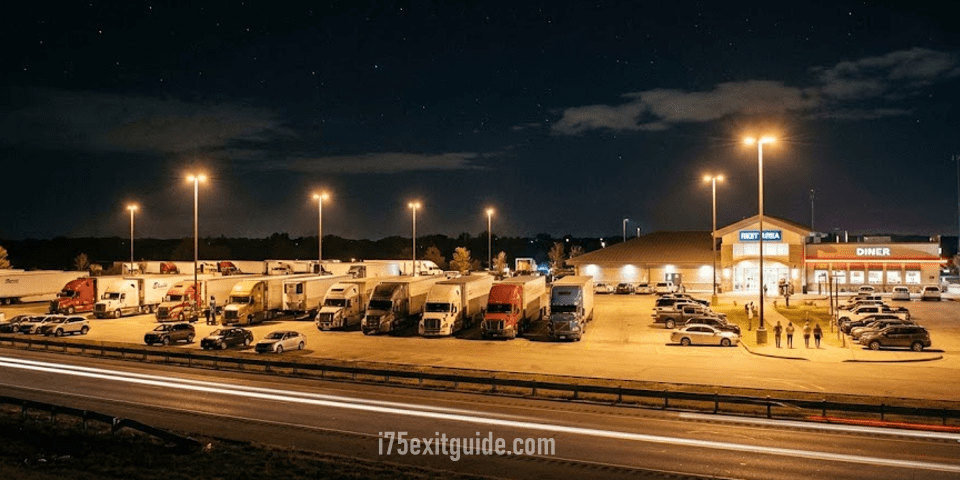
Introduction
I-75 stretches from the Upper Peninsula of Michigan to southern Florida and passes through six states: Michigan, Ohio, Kentucky, Tennessee, Georgia and Florida. Rest areas along I‑75 serve motorists and commercial drivers by providing restrooms, vending machines, picnic areas, and places to park briefly. Overnight parking—meaning remaining in a rest area after closing hours or staying there during the night for sleep or as a temporary campsite—is treated differently from state to state. Whether you decide to use a rest area for an overnight stop, and whether that is lawful, depends on your vehicle type (private passenger vehicle, recreational vehicle, or commercial truck), the state’s statutory law and DOT policy, and the specific posted rules at each rest area. Below are the advantages and disadvantages, followed by state-by-state summary notes (with recommendations to verify current statutes and DOT policies).
Advantages of Overnight Parking in I‑75 Rest Areas
- Convenience and Strategic Locations: Rest areas are sited directly off the interstate, often at convenient intervals, allowing drivers to stop without navigating town traffic. For long‑distance drivers trying to meet hours‑of‑service rest windows (truck drivers) or seeking a place to sleep during overnight travel, a rest area reduces mileage and detours.
- Safety and Enforcement Visibility: Many rest areas are lit, located in view of traffic and law enforcement routes, and sometimes have regular patrols. Compared with stopping on a highway shoulder, a rest area is generally safer for fatigue breaks.
- Basic Amenities: Restrooms, trash containers, bulletin boards, vending machines, pet relief areas and picnic tables are commonly available. For families and pet owners, access to restroom facilities and a level place to stretch reduces travel stress.
- Free of Charge: Unlike private campgrounds or truck stops that may charge fees, public rest areas are typically free to use—an advantage for budget‑minded travelers.
- Short‑Term, Legal Place to Stop for Commercial Drivers: In many states, DOT policy and signage allow commercial truck drivers to use rest areas to take required rest breaks. For interstate truckers complying with federal hours‑of‑service rules, this can be critical.
- Reduced Temptation to Drive Drowsy: Having designated places to stop encourages safer behavior—pulling off the road to sleep is preferable to continuing while fatigued.
Disadvantages and Risks of Overnight Parking in Rest Areas
- Legal Prohibitions and Fines: Many states prohibit “camping,” overnight stays, or loitering in rest areas. Permitted durations vary widely; violators may face fines, citations, or being ordered to move. The absence of a uniform federal rule means the risk depends on the state law or DOT rule where you stop.
- Enforcement Unpredictability: Enforcement practices vary by state, locality and even by individual rest area. What is tolerated at one location may result in citation at another.
- Limited Security and Privacy: Even when lit, rest areas are public and can attract transient populations; privacy and the sense of security are lower than in a private campground or truckstop with manned security.
- Amenities are Sparse for Long Stays: Rest areas are designed for short breaks, not for overnight living. There are no hookups, shower facilities, or services typically available at a truck stop or campground. Facilities may close or be unavailable at night in some locations.
- Noise and Traffic: Rest areas near an interstate can be noisy from continuous interstate traffic, truck engine brakes, and headlights.
- Health and Sanitation Concerns: Some rest areas have limited cleaning schedules; overnight stays increase your exposure to poorly maintained facilities in some jurisdictions.
- Impact on Local Communities and DOT Policy: Long‑term or repeated overnight use by RVs or others can prompt DOTs to tighten rules, post signs limiting parking, or close and redesign rest areas—so the practice can create policy changes that reduce options for everyone.
- Not a Substitute for Safe, Adequate Rest Facilities: For drivers needing guaranteed, safe, and restful sleep (especially professional drivers subject to regulatory compliance), private truckstops, rest plazas with security, or certified safe parking programs may be preferable.
State-by‑State Summaries (I‑75 corridor states)
Important note: The summaries below describe the typical statutory and DOT policy landscape as recognized at the time this article was written. We cannot provide or verify precise statute citations or DOT policy links in real time; please confirm current rules by checking the cited state DOT rest area pages and the state statutes before relying on this information. State listings below run north to south.
Michigan
The Michigan Department of Transportation (MDOT) manages rest areas in the Upper Midwest stretches of I‑75. Michigan’s rest areas typically prohibit camping and long‑term occupancy. Commercial drivers are usually allowed to use rest areas for required rest periods, but some rest areas may limit overnight parking or restrict RV camping. MDOT has been responsive to misuse of rest areas and has added signage where needed to reduce long‑term parking.
- Key Policy: While Michigan lacks a specific statute banning overnight rest, MDOT guidelines discourage stays exceeding a single night. Official camping (tents/outdoor equipment) is prohibited.
- Practical takeaway: Don’t assume rest areas are legal overnight campsites; plan to use truck stops, travel plazas, or campsites when you need full overnight services.
Ohio
The Ohio Department of Transportation (ODOT) historically allows commercial drivers to use rest areas to comply with hours‑of‑service rest periods, and Ohio tends to restrict “camping” and extended overnight usage by recreational vehicles. Some Ohio rest areas have posted time limits (for example, limiting parking to a specific number of hours) or “no overnight parking” signs, and local enforcement can act on violations. Ohio has a substantial truck traffic volume on I‑75, so truck parking spots can be filled early; ODOT tries to balance commercial driver needs with other travelers’ expectations.
- Key Policy: Ohio DOT regulations prohibit “unattended” vehicles from remaining for more than 3 hours, but sleeping while the vehicle is occupied is generally permitted.
- Note: The Ohio Turnpike (not I-75) has different regulations, allowing overnight RV parking for a fee at specific locations.
- Practical takeaway: Confirm posted limits at each rest area; commercial drivers should treat rest areas as short‑duration rest options and plan for alternate truck parking if spaces are full or restricted.
Kentucky
The Kentucky Transportation Cabinet (KYTC) operates rest areas along I‑75’s path in northern Kentucky. KYTC policies generally prohibit camping and overnight stays at rest areas except when specifically allowed (for example, by posted rules or in the case of emergency or official use). Commercial vehicles are usually permitted to take required rests, but KYTC has placed restrictions on long‑term truck parking to preserve spaces and reduce safety issues.
- Key Regulation: 603 KAR 5:040 limits safety rest area use to 4 hours and prohibits using them as “relay stations” for trailers.
- Camping Law: KRS 177.220 and related trespass laws are used to prevent long-term residency, but resting for safety is permitted within the 4-hour window.
- Practical takeaway: Expect signs limiting stay durations or prohibiting overnight parking for non‑commercial vehicles; commercial drivers should follow posted rules and prepare alternative plans if enforcement is strict.
Tennessee
The Tennessee Department of Transportation (TDOT) manages rest areas on I‑75 within Tennessee. Tennessee has policies against camping and loitering in rest areas; however, short breaks for drivers are generally permitted. TDOT has periodically restricted overnight parking at some rest areas due to issues with long‑term occupancy. Truck drivers typically may stop to rest, but state law and DOT policy can limit the duration and manner of parking.
- Key Statute/Regulation: The Tennessee Department of Transportation (TDOT) Rules officially prohibit overnight parking and enforce a strict 2-hour limit.
- Camping Law: The Equal Access to Public Places Act of 2012 (Amended 2022) makes it a misdemeanor to camp on state-owned property, including rest areas, between 10:00 PM and 7:00 AM.
- Practical takeaway: Use rest areas for short rest breaks; don’t plan to use rest areas as a campground. Check local signage or TDOT communications for restrictions at particular rest area locations.
Georgia
The Georgia Department of Transportation (GDOT) rest area policies typically prohibit camping and extended overnight stays in most rest areas. Commercial truck drivers usually can stop to rest, but GDOT enforces parking restrictions—including time limits and prohibitions on using rest areas as long‑term truck parking or for hauling sleeper berths beyond short rest periods. Georgia has also used “No Overnight Parking” signs at some locations, particularly near tourist welcome centers.
- Key Statute: Georgia Code § 32-6-6 prohibits camping on state highway rights-of-way but explicitly excludes the “normal, customary, and temporary use” of rest areas for sleeping or resting.
- Note: Visitor Information Centers often have signs prohibiting overnight parking and may close their restrooms at night (typically 11:00 PM).
- Practical takeaway: Do not assume overnight camping is allowed; look for posted signs and be prepared to move if asked by law enforcement or GDOT personnel. Commercial drivers should be prepared to use designated truck parking if rest areas are full or restricted.
Florida
Florida maintains a network of rest areas and welcome centers along I‑75. Historically, the Florida Department of Transportation (FDOT) has treated rest areas as facilities for short stops and rest, and FDOT signage commonly prohibits camping or extended stays. Commercial drivers generally may use rest areas to meet required rest periods, but Florida has been known to limit long‑term or overnight camping by recreational vehicles. Enforcement is state (or local) driven; some rest areas have explicit posted time limits.
- Key Statute/Rule: Florida Administrative Code (F.A.C.) Rule 14-28.002 outlines the 3-hour limit and 10-hour commercial extension.
- Camping Law: Florida Statute § 125.0231 prohibits “public camping,” but rest stops are considered designated areas for safety-related rest.
- Practical takeaway: Expect that brief overnight stops to rest are often tolerated, particularly for commercial drivers complying with hours‑of‑service rules, but “camping” in an RV or staging for extended stays is often prohibited. Look for posted signage at each rest area and verify with FDOT.
Common Threads and Legal Context Across the States
- No Single Federal Rule: Rest area rules are set by states. The U.S. federal government does not operate interstate rest areas for general public use in the way states do; states regulate activities on rest areas sited within their right‑of‑way and enforce applicable motor vehicle, camping, and loitering laws.
- Commercial Driver Needs vs. Public Policy: States recognize the need for commercial drivers to take rest breaks consistent with federal hours‑of‑service rules, and many DOTs provide or tolerate truck parking for that purpose. However, remaining parked for multiple nights, running generators, dumping waste, or using a rest area as a campsite generally conflicts with DOT goals and posted rules.
- Posted Signs Control: Most rest areas have signs stating allowed uses, parking limits, and prohibitions (for example, “No Overnight Parking,” “No Camping,” or “Truck Parking Only — 3 Hour Limit”). DOT signage ordinarily governs on‑the‑ground conduct; law enforcement and DOT personnel are likely to cite those signs in enforcement.
- Local Law Enforcement Involvement: State police, county sheriffs, or local police often enforce rest area rules and may move people along for loitering, public safety, or sanitation concerns.
- Emergency Exceptions: In emergencies (vehicle breakdown, sudden illness, inclement weather), law enforcement or DOT personnel often permit temporary stops. Keep documentation (e.g., a towing receipt or breakdown report) if you need to explain extended presence.
Best Practices to Minimize Risk
- Look for posted signs at the rest area and obey them.
- If in an RV or passenger vehicle, avoid deploying awnings, chairs, generators, grills, or anything that appears to treat the area like a campsite.
- Keep stays short—overnight for a single night while traveling is less likely to attract enforcement than setting up for multiple nights.
- For professional drivers, document your duty status in your log to show that you are taking federally required rest.
- Be prepared to move if approached by law enforcement or DOT staff.
- Use truck stops, travel plazas, or private campgrounds when you need showers, hookups, or secure long‑term parking.
Conclusion
Overnight parking at I‑75 rest areas offers real benefits—immediate access from the interstate, basic amenities, and often greater safety than the shoulder—but it also comes with legal and practical risks. State DOTs and statutes differ: many states explicitly prohibit camping or extended stays while generally tolerating brief rests, particularly by commercial drivers complying with hours‑of‑service rules. Enforcement and posted rules vary by state and by location, so the safest approach is to check on‑site signage, follow DOT instructions, and confirm state rules in advance when possible. If you want precise, up‑to‑date legal citations (statute numbers and the exact DOT policy language and links) for Florida, Georgia, Tennessee, Kentucky, Ohio and Michigan, tell me and I will fetch and cite each state’s current statute and DOT rest‑area policy (I’ll need the capacity to access the web in real time to do that).
Disclaimer: This information is for general guidance only and does not constitute legal advice. Laws and time limits at I-75 rest areas are subject to change without notice. Always verify rules via official state DOT websites and obey all posted signage. The author assumes no liability for fines, towing, or safety issues resulting from the use of this guide. Rest at your own risk.
The I-75 Exit Guide is the Internet’s largest and most complete website dedicated to Interstate 75 travelers. Find detailed exit service listings… lodging, camping, food, gas and more for every exit from Michigan to Florida!
On the road? Why not take us with you. The I-75 Exit Guide is mobile-friendly and totally FREE. No App Required.
Traveling another route? Visit our growing family of exit guides: I-4 Exit Guide, I-5 Exit Guide, I-10 Exit Guide, I-75 Exit Guide, I-80 Exit Guide and I-95 Exit Guide. Detailed exit service listings… discount lodging, camping, food, gas and more for every exit along the way!